Ten years ago, "influencer marketing" mostly meant a founder DMing a few Instagram accounts and hoping for the best. That's not how it works anymore. Creator partnerships have turned into a structured acquisition channel with budgets, contracts, affiliate codes, and dashboards that finance teams actually ask to see. The global influencer marketing industry crossed roughly $32.5 billion in 2025 and is on pace to pass $40 billion in 2026 — a market that has essentially tripled in five years. Brands aren't dabbling anymore; 86% of US marketers now work with influencers in some capacity, and the average campaign returns close to $5.78 for every dollar spent, with micro-influencer campaigns often performing even better.
That growth is exactly why the old workflow — a shared spreadsheet, a folder of screenshots, and a dozen open DM threads — falls apart so quickly. Once a brand is running barter, paid, UGC, and affiliate campaigns at the same time, across several creators and maybe a couple of agencies, nobody can hold the whole picture in their head. Someone forgets to follow up on a shipped product. Two people negotiate with the same creator. Nobody can say, with a straight face, what the campaign's actual ROI was.
That's the gap influencer marketing software is built to close. A good platform centralizes creator discovery, outreach, contracts, content approval, payments, and reporting so a marketing team can run a campaign without duct-taping together five different tools. But "good" looks different depending on who's asking. A four-person DTC brand running its first barter campaign has very different needs from an agency juggling twelve client accounts, and an enterprise team with a global affiliate program needs things neither of the others do.
This guide walks through five platforms — MyWall, Modash, Upfluence, Influencity, and Later — looking at what each one actually does well, who it's built for, and where the trade-offs are. None of them is "the best" in some universal sense. The goal here is to help you match the platform to your workflow, not to declare a winner.
What Is an Influencer Marketing Platform?
An influencer marketing platform is software that helps brands and agencies run creator campaigns without relying on manual outreach and spreadsheet tracking. Depending on the tool, that can include finding creators, vetting their audiences, managing contracts and briefs, tracking content and deliverables, calculating ROI, and paying creators — often across barter, paid, UGC, and affiliate campaign types at once.
It's worth being clear about what this software is not. An agency runs your campaigns for you — they source creators, negotiate rates, and hand you a finished report, usually at markup and with limited real-time visibility into what's actually happening. A platform, by contrast, gives your own team direct control. You do the work, but the software removes the manual, error-prone parts of it: no more chasing a spreadsheet update, no more digging through DMs to figure out if a creator shipped their content on time.
For marketing teams, the practical benefit shows up in three places. First, time — creator discovery that used to take days of manual searching can take minutes with the right filters. Second, visibility — instead of guessing whether a campaign worked, teams can see real engagement, click, and conversion data tied to specific creators. Third, scale — a brand running five creators on a spreadsheet can usually survive without software. A brand running 50 or 500 cannot.
How We Evaluated These Influencer Marketing Platforms
Comparing influencer marketing software isn't a matter of counting features — a platform can list forty capabilities and still be a poor fit if the ones that matter to your workflow are shallow. We looked at each platform against a consistent set of criteria:
- Influencer discovery — the size and quality of the creator database, and how granular the search filters are
- Creator database quality — how current and how verified the data actually is
- Campaign management — how briefs, approvals, and deliverables are tracked
- Creator CRM — whether relationships, history, and communication are centralized
- Outreach workflow — how invitations, negotiations, and follow-ups are handled
- Reporting & analytics — depth of ROI, engagement, and sales-attribution reporting
- Affiliate management — support for commission-based, sales-driven partnerships
- Product seeding — how barter and gifting campaigns are handled operationally
- Automation — how much manual work the platform actually removes
- Integrations — connections to Shopify, WooCommerce, and other commerce or marketing stacks
- Ease of use — how steep the learning curve is for a new team
- Scalability — whether the platform holds up as campaign volume grows
- Pricing transparency — whether costs are published or gated behind a sales call
- Customer support — the quality and responsiveness of onboarding and support
- Best fit for business size — startup, growing brand, agency, or enterprise
List of Top 5 Influencer Marketing Platforms in 2026
1. MyWall
Overview
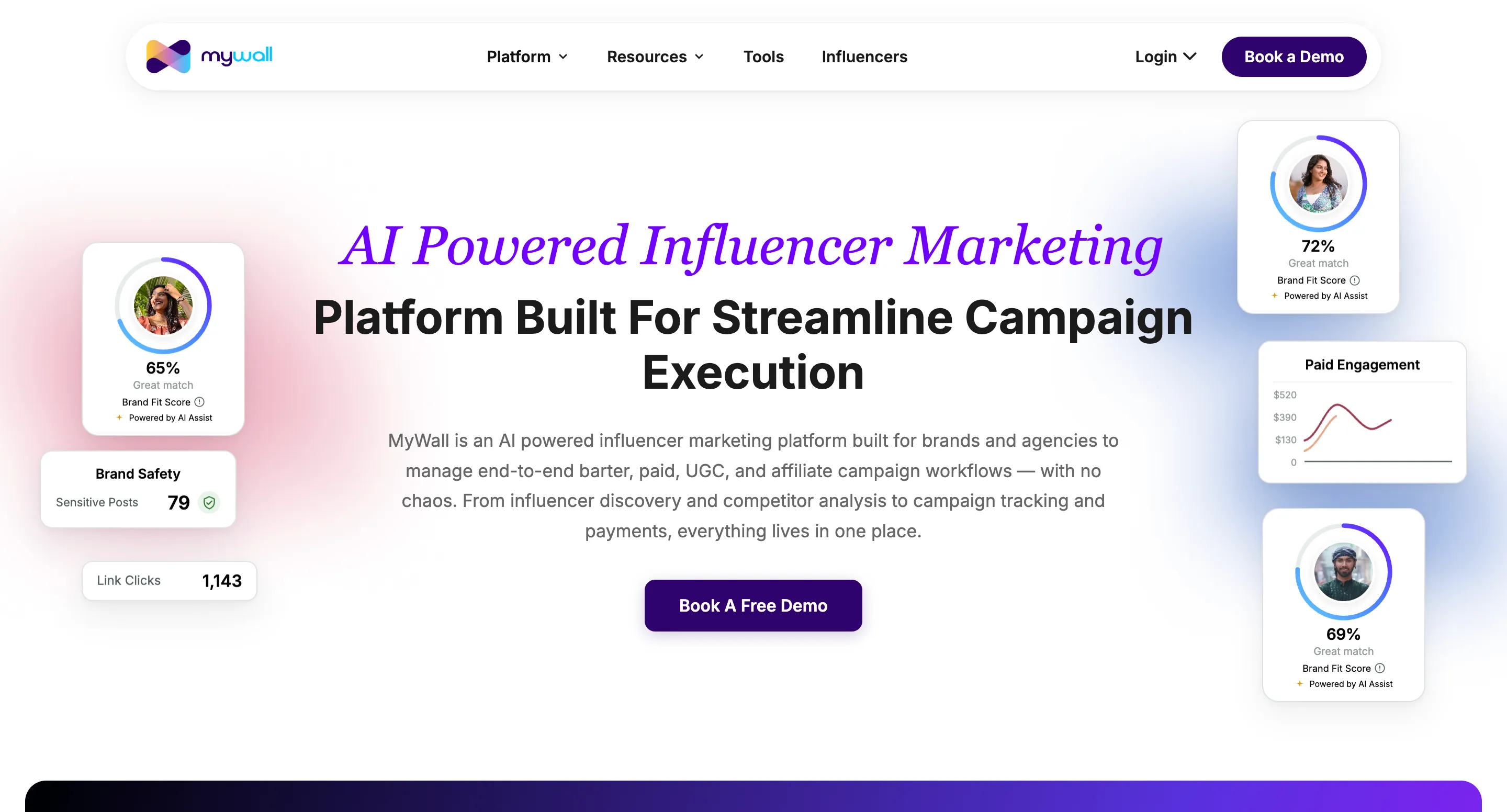
MyWall is an AI-powered influencer marketing platform built for brands and agencies that need to run barter, paid, UGC, and affiliate campaigns without switching between four different tools. Rather than treating discovery, execution, and payments as separate problems, MyWall connects them into a single dashboard — brands can list campaigns publicly through the MyWall Creator App marketplace or run them privately through an internal invite-link workflow, depending on how much control they want over who applies.
Key Features
- Creator discovery across 300M+ profiles on Instagram, TikTok, and YouTube, with filters for niche, sub-niche, location, engagement score, and visual score
- MyWall Genie, a competitor-intelligence tool that shows which creators rival brands are working with and how those campaigns are performing
- AI Executives tool that can automate discovery, outreach, and execution from a single prompt
- Order and sales tracking with native Shopify, WooCommerce, and Magento integrations
- AutoDM for tracking link clicks and conversions directly from creator content
- Wallet-based payments for fast, transparent creator reimbursement
- Support for barter, paid, UGC, and affiliate campaign types within one account
Pros
- Genuinely end-to-end: discovery, execution, tracking, and payments live in one place rather than being stitched together
- Competitor intelligence (Genie) is a differentiator most discovery-first tools don't offer
- Built to work with or without an agency, so brands aren't locked into a middleman
- Strong fit for teams running multiple campaign types (barter and paid and affiliate) simultaneously
Considerations
- As with most full-suite platforms, teams that only need basic discovery may find the broader feature set more than they initially require
- Pricing is quote-based rather than published, so brands will need a demo call to get exact numbers
Pricing
Custom pricing based on campaign volume and feature needs — available by demo request.
Best Use Cases
Brands and agencies managing multiple campaign types at once, teams that want direct creator relationships without agency markups, and businesses that want competitor benchmarking built into their discovery process.
Ideal Business Size
Growing ecommerce brands through enterprise; also well-suited to agencies managing multiple brand accounts.
Notable Integrations
Shopify, WooCommerce, Magento, and custom website tracking.
Unique Strengths
The combination of internal and external campaign management (agency-style oversight plus a public creator marketplace), AI-driven competitor analysis, and unified reporting across barter, paid, UGC, and affiliate formats in a single account.
2. Modash
Overview
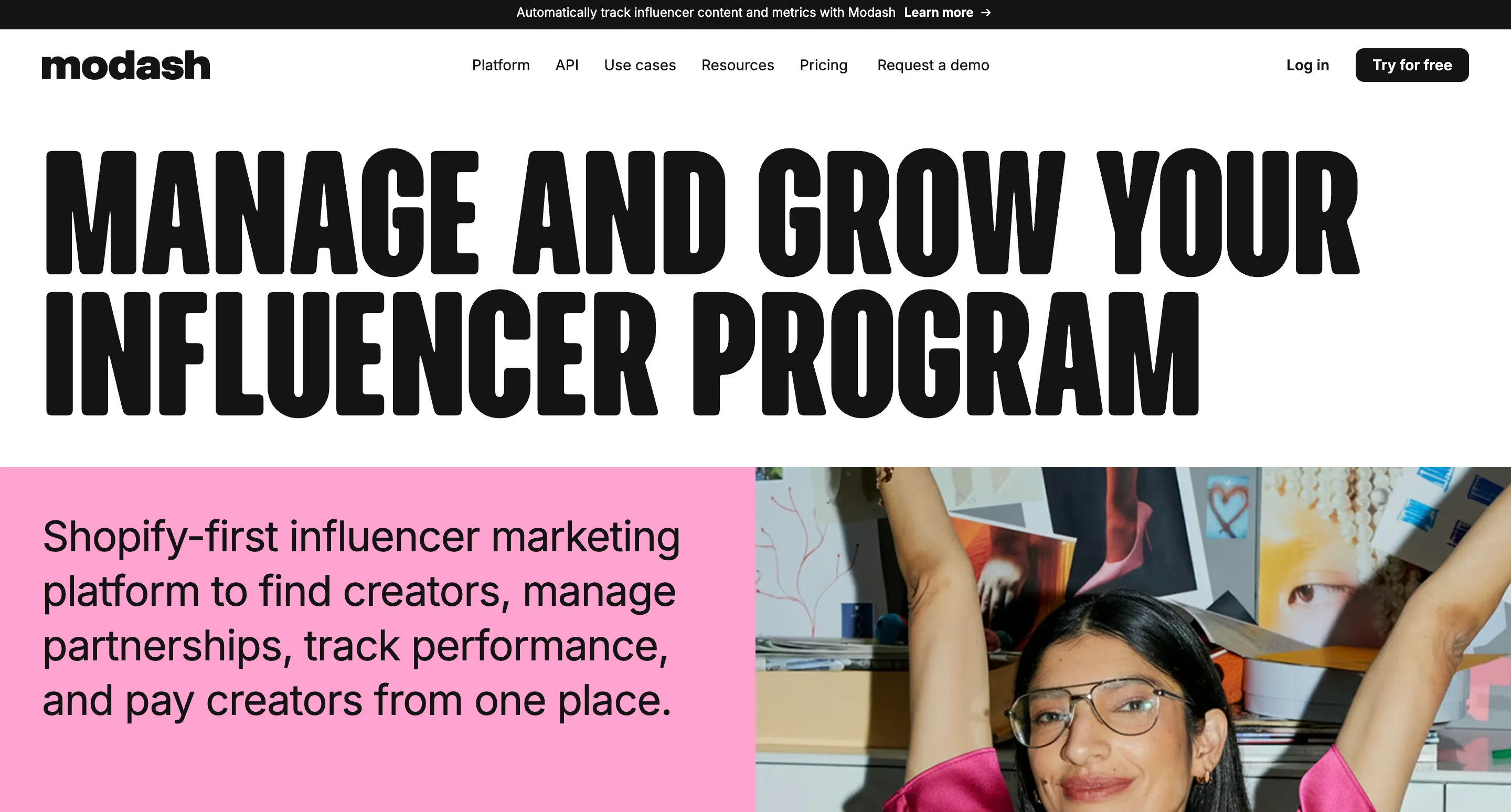
Modash is a discovery-first influencer marketing platform built primarily for Shopify-connected ecommerce brands. It's best known for the size of its creator database — more than 350 million public profiles across Instagram, TikTok, and YouTube — and for keeping its pricing public, which is unusual in this category.
Key Features
- Search and filter across a 350M+ creator database with audience-quality analysis
- Direct outreach using verified creator emails
- Gifting and promo code management, tightly integrated with Shopify
- Content monitoring and campaign performance tracking
- Relationship manager (CRM) for organizing creator pipelines
- A separate Discovery API and Raw API for teams building their own tools on top of Modash data
Pros
- Published, predictable pricing — a rarity among platforms in this space
- Very large, frequently updated creator database
- Strong Shopify-native gifting and affiliate workflow
- 14-day free trial with no credit card required
Considerations
- The platform is built around Shopify; brands on other ecommerce stacks get less value from its integrations
- Search and profile-analysis limits are tied to plan tier, which active teams can exhaust mid-campaign
- Contracting and negotiation still happen largely outside the platform (drafted externally, then tracked manually)
Pricing
Essentials: $199/month (annual) or $299/month (monthly). Performance: $499/month (annual) or $599/month (monthly). Enterprise: custom pricing.
Best Use Cases
Shopify DTC brands that want to run high-volume micro-influencer discovery and gifting campaigns with a transparent monthly cost.
Ideal Business Size
Small to mid-sized ecommerce brands; Enterprise tier extends to larger teams needing SSO and higher usage limits.
Notable Integrations
Shopify (deep), with broader ecommerce support more limited.
Unique Strengths
Database size paired with genuinely transparent, published pricing — most competitors require a sales call before you learn what anything costs.
3. Upfluence
Overview
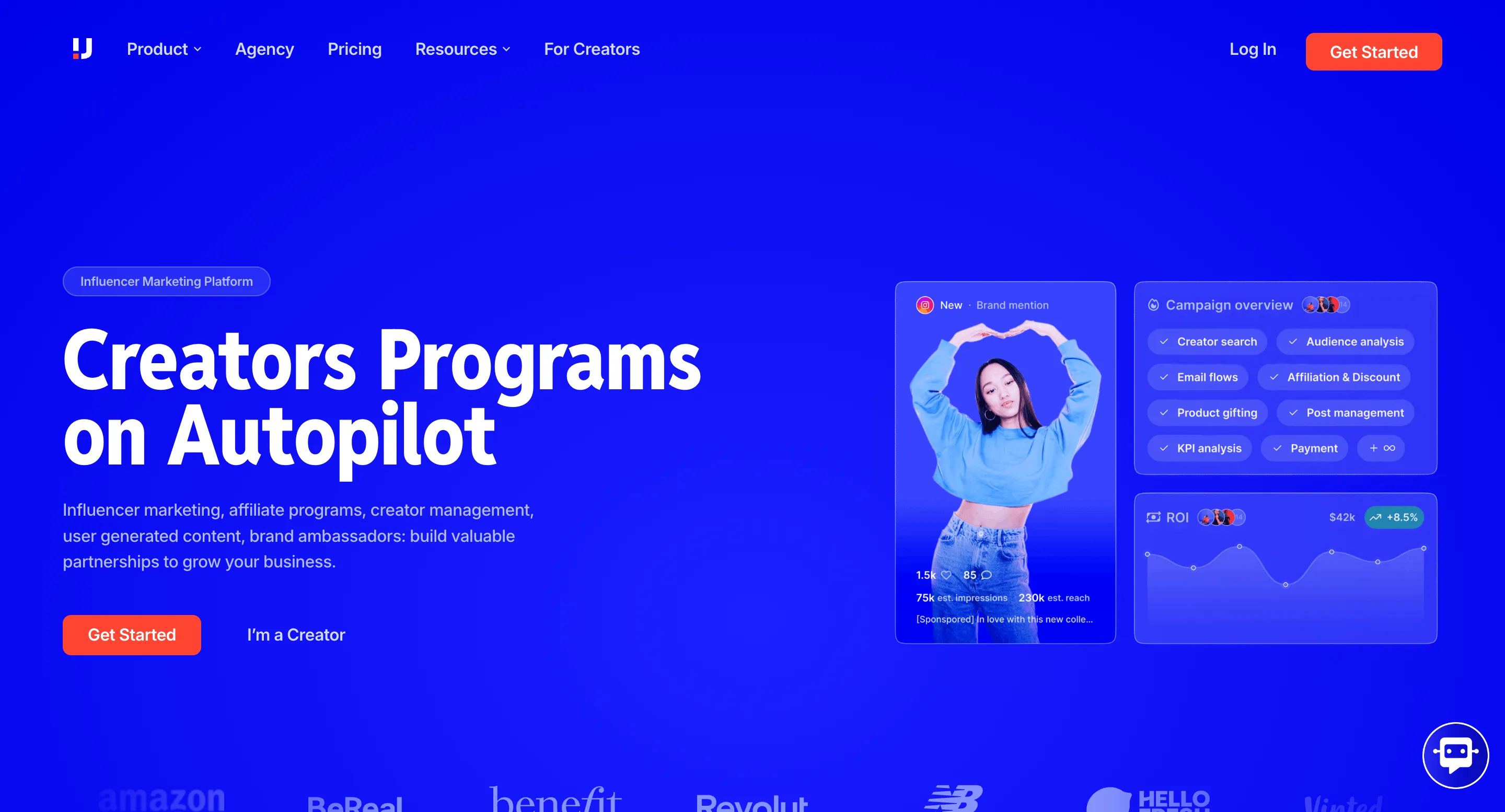
Upfluence built its name on a specific idea: some of your best influencers are already your customers. Its "Live Capture" feature analyzes a brand's own website visitors and buyers to surface people with real social reach, which is a different discovery model than pure database search. Since then, it's expanded into a broader platform covering search, outreach, affiliate tracking, and an AI co-pilot called Jaice.
Key Features
- Live Capture: identifies influential customers directly from website traffic and purchase data
- Creator database of 9M–12M+ profiles with keyword-weighted search filters
- Jaice AI co-pilot for creator matching and outreach automation
- Deep ecommerce integrations: Shopify, WooCommerce, Magento, Klaviyo, and Zapier
- Discount code generation, affiliate sales tracking, and payments through Upfluence Pay
- ROI and revenue-attribution reporting tied to individual creators
Pros
- The "influencers hiding in your customer base" approach is genuinely distinctive and tends to produce cheaper, more authentic collaborations
- Strong ecommerce integration depth for Shopify and WooCommerce brands
- Solid affiliate and discount-code tracking built natively into the platform
Considerations
- Pricing is quote-based and not published; based on public demo reports, full-suite annual licenses commonly run from roughly $1,000 to $3,500+ per month, which puts it out of reach for smaller teams
- Typically requires a 12-month contract
- Automated outreach sequencing is less developed than its search and discovery tools
Pricing
Custom, quote-based. Public estimates suggest annual licenses commonly start in the low four figures per month, scaling with modules and usage.
Best Use Cases
Mid-market to enterprise DTC brands on Shopify, WooCommerce, or Amazon that want to convert existing customers into creators, alongside broader database search.
Ideal Business Size
Mid-market and enterprise; the annual contract and pricing tier make it a heavier commitment for very small teams.
Notable Integrations
Shopify, WooCommerce, Magento, Klaviyo, Zapier, PayPal.
Unique Strengths
Live Capture — turning your own customer and website data into a creator discovery source — is a workflow few competitors replicate.
4. Influencity
Overview
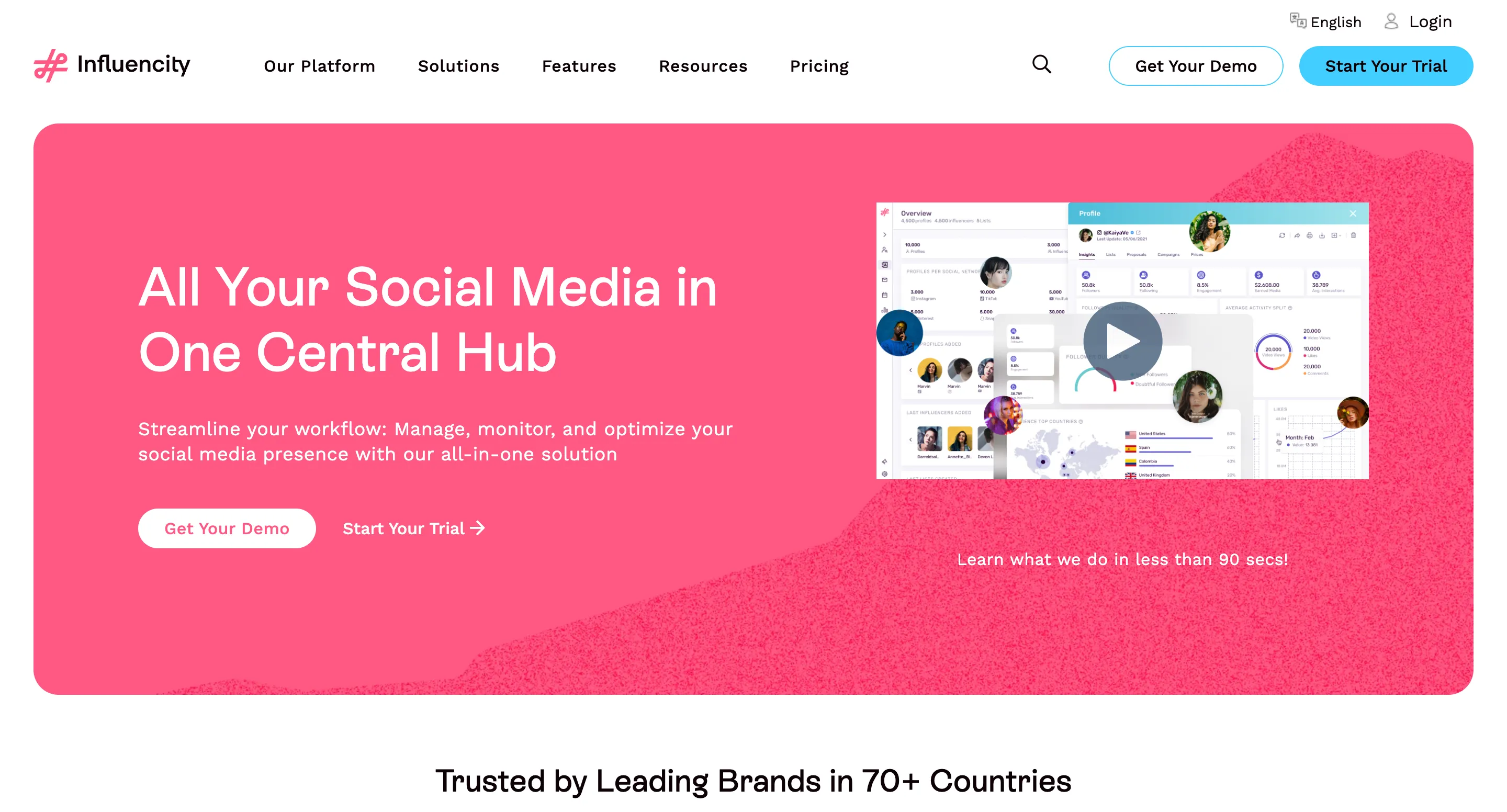
Influencity, based in Spain, is a discovery-and-analytics-focused platform with a large creator database and a reputation for detailed audience insights at a comparatively accessible price point.
Key Features
- Discovery across 200M+ (and by some counts 400M+) creator profiles on Instagram, TikTok, YouTube, and Twitch
- Over 30 search filters, including engagement, brand safety signals, and sentiment analysis
- Audience overlap comparison between creators
- Campaign management for tracking influencer tasks and deliverables
- Real-time influencer and post analysis with demographic breakdowns
Pros
- Strong analytics depth relative to price — detailed audience data without enterprise-level cost
- Wide range of search filters for narrowing down creator fit
- Comparison tools make it easier to choose between similar creators
Considerations
- Outreach is largely limited to email integration rather than a fuller in-platform messaging workflow
- No free plan, and analysis credits are capped by tier, which active campaign teams can burn through quickly
- Lacks native UGC capture, Stories monitoring, and affiliate-heavy workflows that some competitors offer
Pricing
Professional: roughly $318/month (annual) or $398/month (monthly). Basic tiers start around $168–$198/month. Enterprise: custom pricing.
Best Use Cases
Brands and small agencies that want strong discovery and audience analytics without committing to enterprise-tier pricing.
Ideal Business Size
Small to mid-sized brands and agencies running a handful of active campaigns at a time.
Notable Integrations
Primarily email-based outreach integration; fewer native ecommerce connections than Modash or Upfluence.
Unique Strengths
Depth of audience and brand-safety analytics relative to its price point.
5. Later
Overview
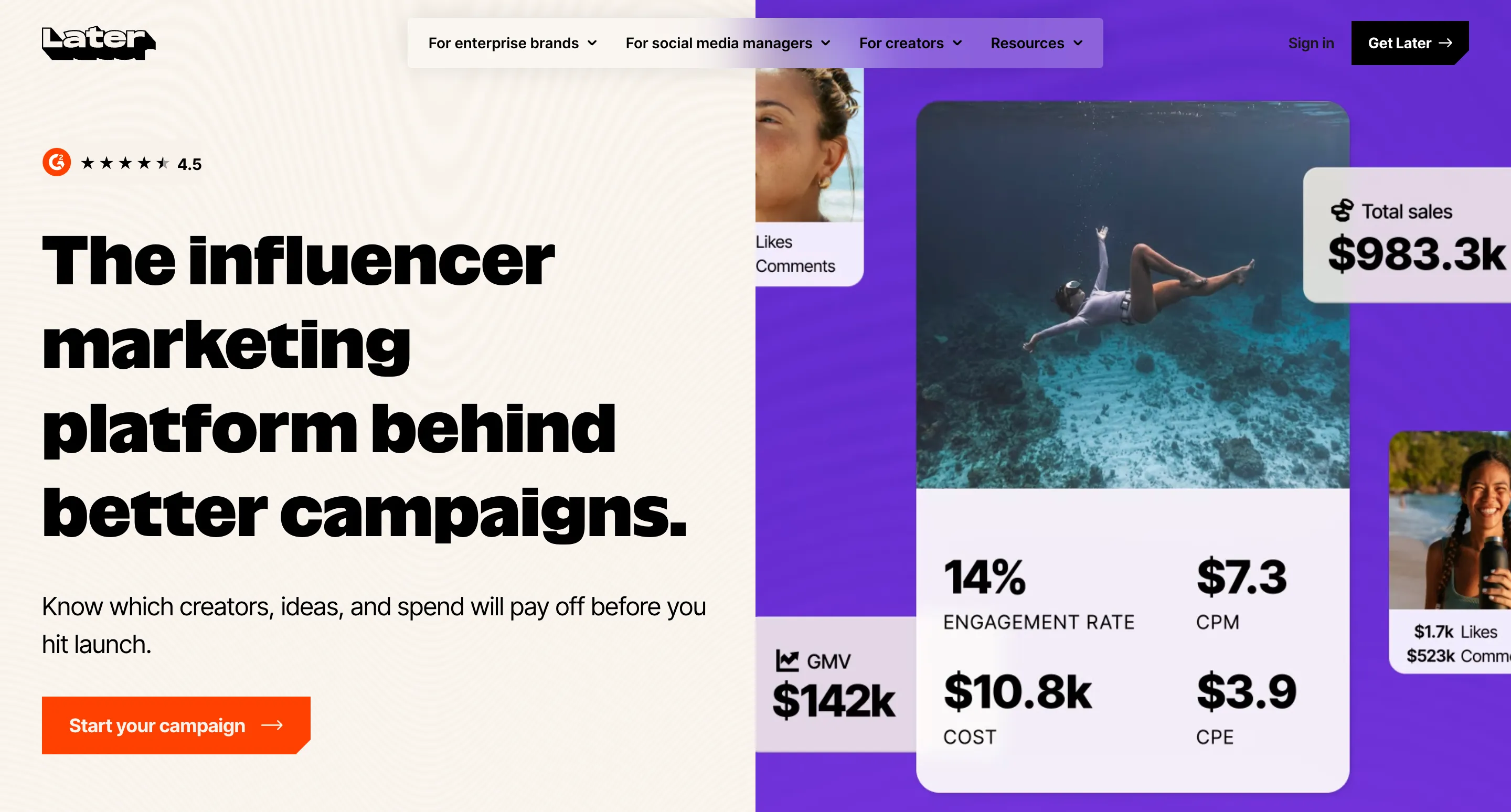
Later Influence (formerly Mavrck) became part of Later — the social media scheduling and link-in-bio company — in 2024. Its main advantage is context: if a team already uses Later Social for content scheduling, adding the Influence module creates one connected workflow instead of two separate logins.
Key Features
- Influencer Index with 10M+ opted-in creators, filterable by 20+ criteria
- Campaign management from onboarding through content review
- Integration with Later's broader social scheduling and link-in-bio tools
- Automated workflows and stage-based creator communication
- Real-time analytics and AI-assisted social listening for brand mentions
Pros
- Genuinely useful if your team already runs Later for scheduling — one ecosystem, one login
- Opt-in-only creator database, which some brands prefer over broader scraped databases
- Comparatively accessible entry pricing versus enterprise competitors
Considerations
- The creator pool is smaller and opt-in-only, which can be limiting if you need very specific niches or geographies
- Budget management and deeper reporting have been flagged by users as areas needing work
- No longer offers a free plan as of 2025
Pricing
Plans starting around $16.67/month (billed annually) for entry tiers, scaling up based on features and usage; higher tiers require custom quotes.
Best Use Cases
Teams that want influencer marketing and social media scheduling under one platform, particularly those already invested in Later's ecosystem.
Ideal Business Size
Small to mid-sized social-first teams; less suited to complex, multi-campaign-type enterprise programs.
Notable Integrations
Meta, TikTok, X/Twitter, LinkedIn, YouTube, Snapchat, Pinterest.
Unique Strengths
Combined influencer marketing and social media management in one connected platform — a meaningful convenience for teams already scheduling content through Later.
Best Influencer Marketing Platforms Pricing Comparison
| Platform | Entry Pricing | Mid-Tier | Enterprise |
|---|---|---|---|
| MyWall | Custom pricing available upon request | Custom pricing available upon request | Custom pricing available upon request |
| Modash | $199/mo (annual) | $499/mo (annual) | Custom pricing available upon request |
| Upfluence | Custom pricing available upon request | ~$478–$1,000+/mo (based on public estimates) | $2,000–$3,500+/mo (based on public estimates) |
| Influencity | ~$168–$198/mo | $318–$398/mo | Custom pricing available upon request |
| Later (Later Influence) | ~$16.67/mo (annual) | Custom pricing available upon request | Custom pricing available upon request |
Pricing changes frequently in this category, and several vendors negotiate final rates based on team size, creator volume, and contract length. Treat the figures above as a starting reference point, not a quote, and confirm directly with the vendor before budgeting.
How to Choose the Right Influencer Marketing Platform
Budget. Published pricing (Modash, Influencity, Later) makes early-stage budgeting easier. Custom-quote platforms (MyWall, Upfluence) usually reflect more tailored feature sets but require a sales conversation before you can compare true cost.
Campaign volume. A brand running five collaborations a quarter doesn't need the same tooling as one running five hundred. Check the platform's usage caps — search credits, tracked creators, active campaigns — against your real monthly volume, not just this month's.
Team size. Some platforms charge per seat; others include unlimited users at a given tier. If multiple people (marketing, finance, creative) need access, seat-based pricing can add up fast.
Creator relationships. If your program leans on long-term ambassadors rather than one-off posts, prioritize CRM depth over pure discovery volume.
International campaigns. Confirm the platform's creator database has meaningful coverage in your target markets — a 300M-profile database is only useful if a meaningful share of those profiles are relevant to your regions.
Automation needs. AI-assisted discovery and outreach (MyWall's AI Executives, Upfluence's Jaice) can meaningfully cut manual hours, but only if your team actually adopts the automated workflow rather than defaulting back to manual habits.
Reporting requirements. If your finance team wants hard ROI numbers, not just engagement metrics, prioritize platforms with native sales tracking (Shopify/WooCommerce integration) over ones that only report reach and likes.
Integrations. Check compatibility with your actual ecommerce and marketing stack before signing — a platform that's "Shopify-first" won't deliver the same value on Magento or a custom-built store.
Future scalability. Consider not just where your program is today but where it'll be in 12–18 months. Switching platforms mid-program is disruptive; it's worth paying slightly more now for headroom later.
Why Many Growing Brands Choose MyWall
A recurring theme across the platforms in this guide is that most of them do one or two things very well and leave the rest of the workflow to other tools — Modash for discovery, Upfluence for customer-to-creator matching, Influencity for audience analytics, Later for social scheduling synergy. That's a reasonable trade-off for teams with a narrow, well-defined need.
MyWall's positioning is different: it's built around the idea that a brand shouldn't need four subscriptions to run one influencer program. Discovery, campaign creation, content tracking, order and sales attribution, affiliate management, and creator payments all live inside the same account, whether the campaign is barter, paid, UGC, or affiliate. For teams that are actively scaling — running several campaign types simultaneously, working with both an internal team and outside agencies, or trying to get a real read on ROI without exporting data into three spreadsheets — that consolidation tends to matter more than any single standout feature.
The addition of MyWall Genie, which surfaces what competitors' campaigns are actually doing (which creators they've worked with, what content performed, where the engagement gaps are), also gives brands a way to plan strategy with real market context rather than guessing. And because MyWall supports both public marketplace listings and private, invite-only campaigns, brands can run agency-style oversight and a self-serve creator marketplace side by side, depending on what a given campaign needs.
None of that makes MyWall the automatic right choice for every brand — a five-person startup running its first small gifting campaign may be better served by a lighter, cheaper tool. But for brands and agencies that have outgrown spreadsheets and are trying to run influencer marketing as a repeatable, measurable channel rather than a series of one-off experiments, the case for a connected platform like MyWall gets stronger with every additional campaign type added to the mix.